
Research & Trials
Built through trial, feedback and university collaboration.
ModnyVR is being developed through a continuous Build → Trial → Measure → Refine process. Early learner feedback has already shaped the Beta, while university trials and supervised R&D activity are helping the platform progress toward institution-ready deployment.
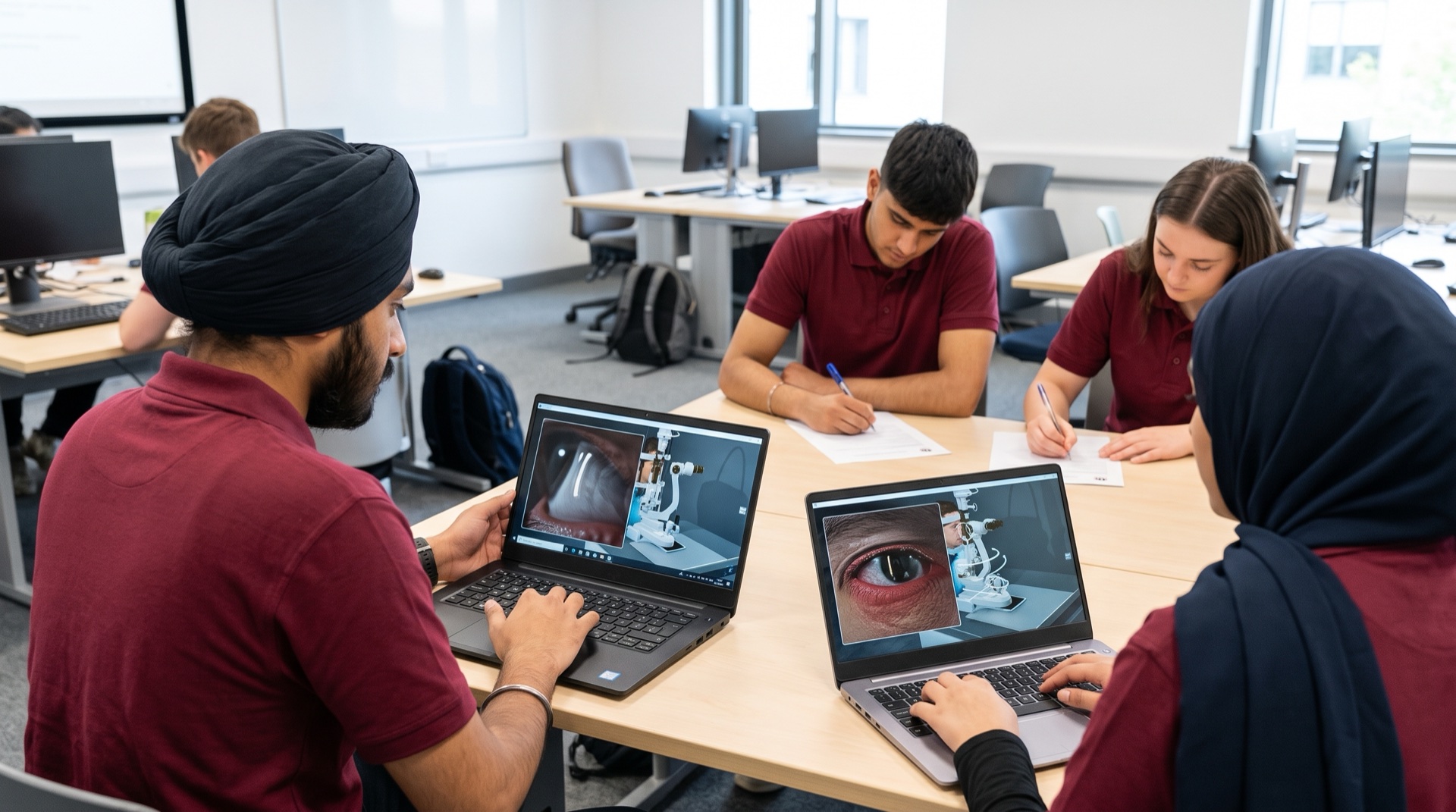
Development loop
Build → Trial → Measure → Refine.
The product roadmap and university validation remain connected. Changes to the core simulation, pathology content, guided interaction, assessment and deployment can be tested with learners and educators, measured against defined outcomes and refined before wider roll-out.
As trials mature, priority measures can include usability, additional practice created, learner confidence, pathology exposure, educator perceptions, deployment reliability and readiness for real clinical teaching. Claims about time or cost savings will only be added when supported by evidence.
- Build
- Trial
- Measure
- Refine
Back to Build
From Alpha to paid university trial.
-
Alpha

13students
An early, pathology-free interactive simulation was tested with optometry students, educators and practising optometrists at Aston University to identify technical limitations, unexpected behaviour, usability issues and priorities for future development.
Average responses from the 13-student Alpha evaluation were:
- Ease of controlEasy
- RealismVery realistic
- Course usefulnessExtremely useful
- Learning engagementVery engaging
- Compared with traditional methodsMore useful
These findings are direct early user feedback from a small sample. They are validation of usability, realism and perceived training value, not proof of long-term educational outcomes.
-
Beta — Phase 1
The first Beta phase introduces a limited pathology library to Year 1 and Year 2 optometry students, measuring changes in confidence with slit-lamp control while gathering structured feedback on usability and product development.
Results pending
This phase will report on the same measures as the Alpha:
- Ease of control
- Realism
- Course usefulness
- Learning engagement
- Compared with traditional methods
-
Beta — Phase 2
Phase 2 adds an extended pathology library, virtual-patient conversation and conversational clinical guidance. Students will evaluate confidence in full eye examination and clinical reasoning while providing structured feedback to guide further product development.
Results pending
This phase will report on the same measures as the Alpha:
- Ease of control
- Realism
- Course usefulness
- Learning engagement
- Compared with traditional methods
-
Beta — Phase 3

Phase 3 extends the advanced simulation to Year 1 and Year 2 students at the University of Waterloo, evaluating confidence in eye examination and clinical reasoning while beginning ModnyVR’s international validation and expansion.
Results pending
This phase will report on the same measures as the Alpha:
- Ease of control
- Realism
- Course usefulness
- Learning engagement
- Compared with traditional methods
Collaborate